Fossil DNA Could Save Species


For Mike Bunce, the skin, bones and dung of ancient Australian native animals are much more than the sum of their parts -- they are a time machine to the past.

Bunce, who heads the ancient DNA lab at Murdoch University in Western Australia, searches the remnants of long-dead animals and plants for clues about how to conserve their modern-day descendants.
Known as "conservation paleobiology," this emerging field of science relies heavily on fossil and ancient pollen analysis together with carbon dating and, importantly, ancient DNA analysis to answer vital questions about the history of endangered species like discovering where an endangered species lived hundreds of years ago, to how it coped with massive changes in the environment.

As Bunce explains, the field has only recently gained momentum thanks to our growing knowledge about the genetic make-up of modern species, currently available genetic tools and the falling cost of DNA analysis.

"There are a variety of genetic tools now at the disposal of scientists, and these tools have had meaningful impacts in managing modern populations," he says. "It is only natural that this is now spilling over into the past to help us better understand things like biodiversity loss."

And analyzing ancient DNA isn't just a fancy form of fossil analysis.

While the fossil record might show a particular species living in one place for tens of thousands of years, the genetics of those fossils might reveal "entire genetic types disappearing and new populations invading" says Alan Cooper, director of the Australian Centre for Ancient DNA at the University of Adelaide.

"It puts a whole new perspective on the fossil record," he added.

Knowing where a species lived in the past can help with decisions about reintroduction to a new area and interbreeding animals from different modern populations.

"If we're looking at re-establishing an ecosystem to what it formally looked like it's important that we know what used to live there not hundreds of years ago but thousands of years ago," Bunce says.

For example, Bunce's team has found that the woylie, a small marsupial whose numbers have declined rapidly, particularly in the past decade, used to live over the entire south-west of Western Australia.

"We can tell that genetic signatures used to move around the entire south-west area," says Bunce.

There are now only a few isolated woylie populations left. "So we can't really get too precious about interbreeding these populations now because in the past they were definitely connected."

The research also found that the woylie has lost around 90 per cent of its genetic diversity since Europeans arrived with feral animals 200 years ago. But all is not lost.

"Genetic diversity take times to build. You can also use modern genetic tools to make decisions to breed certain animals to facilitate gene flow," says Bunce.

But not all modern populations of animals can be interbred.

Jeremy Austin, deputy director of the Australian Centre for Ancient DNA, was recently involved in research using museum specimens thousands of years old to determine the past geographical range of modern day Victorian and NSW rock wallabies.

Because the two belong to distinct genetic lineages, interbreeding can lead to 'nasty genetic effects', says Austin, so mapping their old ranges means that conservationists now know which type of animal to reintroduce to particular areas.

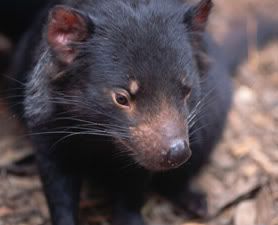
One of Australia's most beloved animals, the Tasmanian devil, is also in need of a helping hand from ancient DNA.

More than 70 percent of devils have been infected with facial tumor disease, a contagious cancer that can spread between devils because of a lack of genetic diversity.

Recently, scientists have suggested that a population of devils in the northwest of Tasmania may be resistant to the disease because they have a different variant of the "major histocompatibility complex" (MHC) gene family.

The MHC genes code for proteins that ensure the body launches an immune response against foreign tissue. If two animals have the same MHC genes, cancerous tissue passed from one to another won't be rejected, allowing the cancer to take hold.

Austin and his team are using DNA from museum specimens to find out when devils may have lost genetic diversity in their MHC genes and the genetic impact of the disease in the past.

"The important question is have devils had this disease for thousands of years and been surviving until they lost diversity when Europeans arrived? Or is it just an accident that the disease has turned up and taken advantage of the low diversity?" says Austin.

And if devils survive the disease it will be important to know how much of past genetic diversity remains, to assess how much they will be able to adapt to changes in the environment or new diseases, says Austin.

Ancient DNA can also tell us how species could respond to climate change, says Cooper.

Scientists are busy modeling how the climate will change as average temperatures increase, but the impact this will have on animals and plants has received less attention because it's much more difficult to predict how complex ecosystems will respond, he says.

"That's where conservation paleobiology comes into its own," he says. "You're taking information from the past, during, for example, periods of rapid climate change, to look at consequences that you can't gain from looking at the last few hundred years."

Looking at DNA from animals that lived between 18,000 and 10,000 years ago (from just after the last glacial period to the beginning of the Holocene period) allows us to observe a huge 'experiment' as the Earth warmed, he says.

"The most surprising stuff ... is the incredible dynamism of the response of populations to climate: how violent it is; there are extinctions and migrations and replacements -- huge see-sawing of populations. That's the kind of thing we absolutely need to know about if we're trying to predict what are the consequences of temperature change."

But however good researchers become at inferring the future from the past, and however sophisticated technologies become, they will always be constrained by the lottery of past conditions.

Australia is a challenging place to work with ancient DNA, says Bunce. The hot climate means it rarely remains intact.

"Antarctic environments allow for conditions that preserve DNA for up to one million years but the oldest DNA we've managed to get from Australian conditions is about 20,000 years old," says Bunce.

Bunce's team often take sediments from cave sites, such as Western Australia's South-West Caves, for analysis because they tend to be protected from the wildest swings in temperature.

Scientists are always going to be working with tiny fragments of DNA, adds Cooper, and are always going to need specimens to have that unique set of circumstances for the DNA to be preserved.

"That's always going to give you a limited pool of samples to work from," he says.

But the work is essential, says Austin.

Australia has the highest rate of terrestrial vertebrate extinction in the last 200 years and many species on the endangered list.

"For all the wrong reasons we should be at the forefront of using ancient DNA to try and save what's left," he says.

[Sources : discovery]

[Read More...]


Rare, Apocalyptic Supernova Ocurred 160 Million Years Ago


New developments in the observation of supernovae are providing increasing evidence that the explosion of a star can result in a strongly deformed fireball. The image above shows a Ib supernova 2010O is thought to be an explosion in a Wolf-Rayet X-ray binary.

A few, rare supernovae arise as a result of the interaction of white dwarfs with other stars placed very close to them -the so-called thermonuclear supernovae. Other explosions, core-collapse or gravitational supernovae, happen when very massive stars die (like the Wolf-Rayet Star remnants above). These stars have consumed the fuel that makes them shine, the energy source that supports their internal structure against the tendency to shrink and collapse due to the pull of gravity. They suffer an energy crisis that leads to an extremely violent collapse and, after that, to an explosion of awesome, apocalyptic finality.
Type IIn gravitational supernovae are the rarest of all, with only three of this type ever observed; in all three cases astronomers found strong evidence of an asymmetric fireball .

The most recent of these studies was conducted by an international team of astronomers lead by F. Patat (ESO, Garching, Germany), who observed supernova 2010jl in November 2010 using Calar Alto telescopes and a technique called spectropolarimetry, which allows to infer information on the shape of an object, even though the object itself appears as a simple, tiny point at the telescope.

Supernova 2010jl was observed in the constellation Leo some 160 million light-years away during the first days of November 2010. Its host galaxy was UGC 5189A, a strangely shaped specimen, an example of a galaxy in strong tidal interaction with some neighbouring galaxies. Such interaction usually leads to an intense formation of new stars, the more massive of which later will appear as gravitational supernova.

In the case of SN 2010jl, it has been estimated that the parent star had a mass at least around thirty times that of the Sun. Such heavy massive stars drive consume their resources rapidly and shine only for a few million years The intense energy output tears material out from the stellar surface. So, the star is continuously emitting not only energy, but also some amount of matter, atomic and subatomic particles that constitute the stellar wind and form an envelope around the star. When the final moment comes and the star explodes as a gravitational supernova, the expanding fireball collides with this envelope, and emits light due to processes that happen both inside the hot gas and at the contact surface between the hot gas and the envelope.

In SN 2010jl the asymmetry caused by an intrinsically non-spherical explosion, or a more symmetrical fireball interacting with an elongated envelope-the team is not sure. In either case, both the explosion and the envelope come from the same almost spherical star. Rotation and magnetic fields are no doubt involved in the generation of the asymmetry, but further studies are needed to clarify this point.

The Daily Galaxy via Calar Alto Observatory-CAHA and physorg.com

Image credit" NASA, ESA, the Hubble Heritage (STSd/AURA)-ESA/Hubble Collaboration, and A. Evans; Inset: NASA, ESA and H. Bond

[Sources : DailyGalaxy]
[Read More...]


Ancient dominatrix mites found trapped in amber while mating


40-million-year-old extinct mites were trapped while displaying unusual mating behavior in which the female dominates.

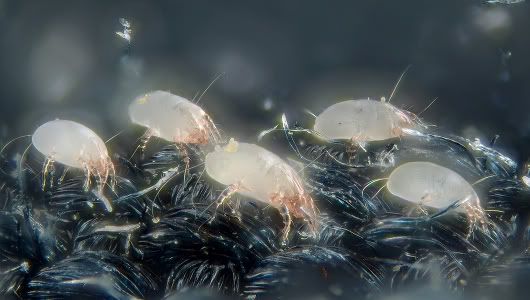
Researchers studying ancient amber deposits have discovered the closest thing in nature to a scandalous mite sex tape. Two members of an extinct, 40-million-year-old species of mite were found trapped in the amber while displaying unusual sexual behavior in which the female dominates the male, according to PhysOrg.com.

In most species of modern mite, it's the male that is in control of copulation. Aside from harassing reluctant females by guarding them from engaging with other males, male mites of some species have evolved specialized clinging organs that grapple the females and force them into sex.

As the act frozen in amber now suggests, however, mite sex roles weren't always this way. In fact, sex roles appear to have been reversed for the ancient species.

"In this species, it is the female who has partial or complete control of mating," said Pavel Klimov, an associate research scientist at the University of Michigan Museum of Zoology. "This is in contrast to the present-day reproductive behavior of many mite species where almost all aspects of copulation are controlled by males."

In fact, it's the females from the extinct mite species (Glaesacarus rhombeus) that harbor the specialized, pad-like, clinging sex organs. Klimov even describes some types of these female clinging structures as "copulatory tubes that function like a penis."

So what happened to these dominatrix mites? Why did they go extinct? Scientists suggest that a biological battle of the sexes has been raging throughout evolutionary history. Both genders struggle to gain the upper hand in controlling how their genes get passed on to the next generation. It's an evolutionary cycle that occasionally gets played out in extremes, such as with these mites.

Scientists have long suspected that sex role reversals have occurred throughout mite evolution, but it wasn't until this discovery that they could confirm it. Finding a fossil is one thing; finding perfectly preserved animal behavior is something rare.

Who knows what others kinds of oddball behavior, scandalous or otherwise, scientists may find as they continue to mine these amazing amber deposits for more rare snapshots of biological history?

[Read More...]


Giant Underground Chamber Discovered On the Moon


Back in 2009, the Japanese Space Agency JAXA announced moon hole deep enough to contain a small human base. Now, the Indian Space Research Organization has discovered a "giant underground chamber" near the Moon's equator, in the Oceanus Procellarum area.

The huge cave— discovered by the Chandrayaan-1 spacecraft—is more than one mile long (1.7 kilometers) and 393 feet wide (120 meters). By comparison, the vertical hole that Jaxa discovered was only 213 feet (65 meters across) and 289 feet deep (88 meters). This new chamber is big enough to contain a small lunar city or a secret Nazi base with a few thousand UFOs.

The Indian researchers have published a paper detailing their findings and talking about the possibility of making this giant underground vault as a future human base. The settlement would be protected from radiation, micro-meteor impacts, dust and extreme temperature changes by the lava structure:

Lava provides a natural environmental control with a nearly constant temperature of minus 20 degrees Celsius (-4 degrees Fahrenheit), unlike that of the lunar surface showing extreme variation, maximum of 130 degrees Celsius (266 degrees Fahrenheit) to a minimum of minus 180 degrees Celsius (-292 degrees Fahrenheit) in its diurnal (day-night) cycle.

Giant Underground Chamber Discovered On the Moon They also point out that explorers would only need minimal construction, without the added cost of having to use expensive shields against the hazardous lunar environment.

If humans ever colonize this chamber, I hope they call the city Attilan. [Silicon India]

[Sources : gizmodo]
[Read More...]


How Did the Mouse Get Its Color?


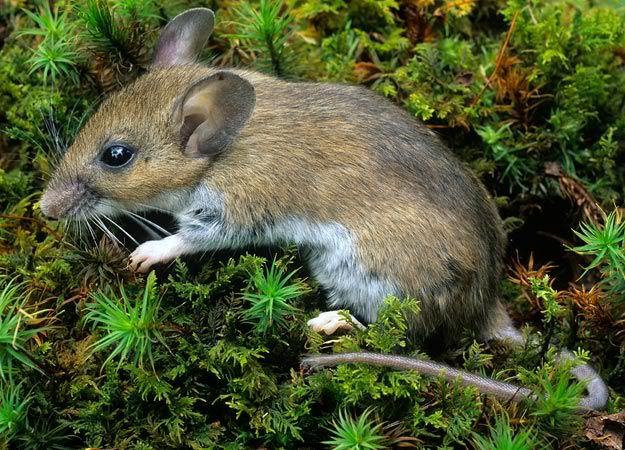
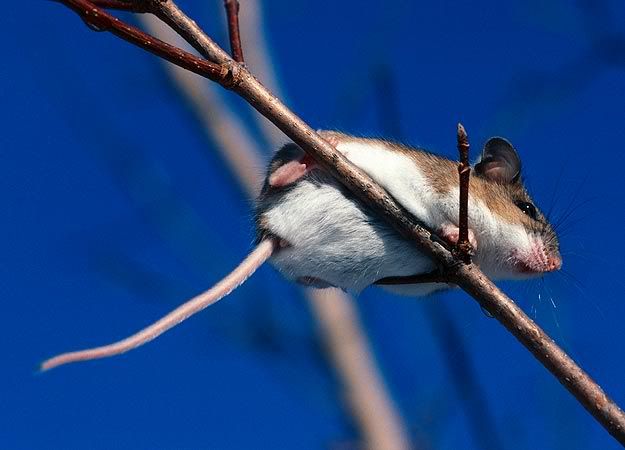
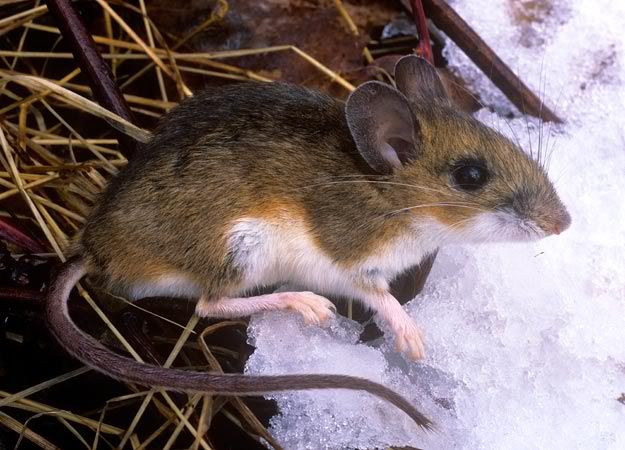
Scientists finally have the answer to this question. A team of researchers at Harvard University say a gene named Agouti is responsible for the color patterns in deer mice and possibly all vertebrates. The research appears this week in the journal Science.


"Taking advantage of the simple color pattern of deer mice -- which have a dark back and a light belly -- we showed that small changes in the activity of a single pigmentation gene in embryos generate big differences in adult color pattern,” says Marie Manceau, a research associate in Harvard’s Department of Organismic and Evolutionary Biology.


Small changes in Agouti gene expression could literally change the pattern of a leopard’s spots. In deer mice, natural selection determines the amount of Agouti expression, thus determining the color patterns that help them and other animals camouflage and hide from predators.


[Sources : Animal Descovery]
[Read More...]


Your Comments

Followers

Return to top of page Copyright © 2010 | Platinum Theme Converted into Blogger Template by HackTutors